




By Sigve Brekke | Group CEO, True Corporation Public Company Limited
Advances in artificial intelligence are drawing a new wave of global capital into the economy, from data centers and servers to AI models and autonomous agents that can carry out tasks on our behalf. Together, these investments are turning AI into a new operating system for the global economy, reshaping how businesses work and how economic value is created.
Thailand is already part of this cycle. In the first half of 2026, applications for investment promotion reached 1.47 trillion baht, up 37% from a year earlier, according to the Board of Investment. Digital projects accounted for 1.12 trillion baht, or roughly 76% of the total.
This capital is changing Thailand’s position in Southeast Asia, particularly as a strategic location for AI infrastructure and data centers. But hosting infrastructure is not the same as capturing lasting value. The real return depends on converting investment into capabilities businesses can use, higher productivity, and growth that people across Thailand can share.
This matters for a country that has spent decades in the middle-income trap. Thailand cannot afford to miss this moment, and solving a structural problem means starting where it runs deepest, with SMEs.
Why SMEs Sit at the Center
The World Bank estimates that SMEs account for 99.5% of firms in Thailand and 69.5% of employment, but only 35.3% of GDP. This gap points to a productivity challenge. Around 85% are micro-SMEs, with no more than five employees and annual revenue below 1.8 million baht.
AI can become an equalizer if smaller businesses are able to access capabilities that once belonged mainly to large companies. It should not replace what Thai SMEs already do well, including local knowledge and close customer relationships. It should help those strengths travel further.
Salesforce research found that around 70% of Thai SMEs are using or experimenting with AI. Yet many use it as little more than an advanced search tool. AWS’s Unlocking Thailand’s AI Potential 2026 report found that 74% of Thai AI adopters remain at the basic stage, 17% are intermediate and only 9% have reached advanced adoption.
The challenge, therefore, is not simply to get SMEs to start using AI. It is to help them use enough of AI’s potential to change how they operate, compete and grow. That journey can be understood in three levels.
The first level is AI-assisted. A small online store uses AI to write product descriptions, edit photos and answer customer chats. The work gets faster, but the owner still makes every decision.
The second is AI-operated. The same store redesigns its workflow around AI. Sales from every platform flow into one system, and AI forecasts demand, restocks inventory, adjusts prices and allocates ad spending. It still sells the same products, but the owner oversees the system and can enter new markets without adding staff.
The third is AI-native. The same store starts selling the AI system that worked for it to other small retailers. Its main revenue now comes from AI capability, not products. Such businesses already exist. Atoms, a Chinese platform where AI agents do the work of researchers, product managers and engineers, lets a single founder turn an idea into a revenue-ready business.
A Framework for SMEs in the AI Era
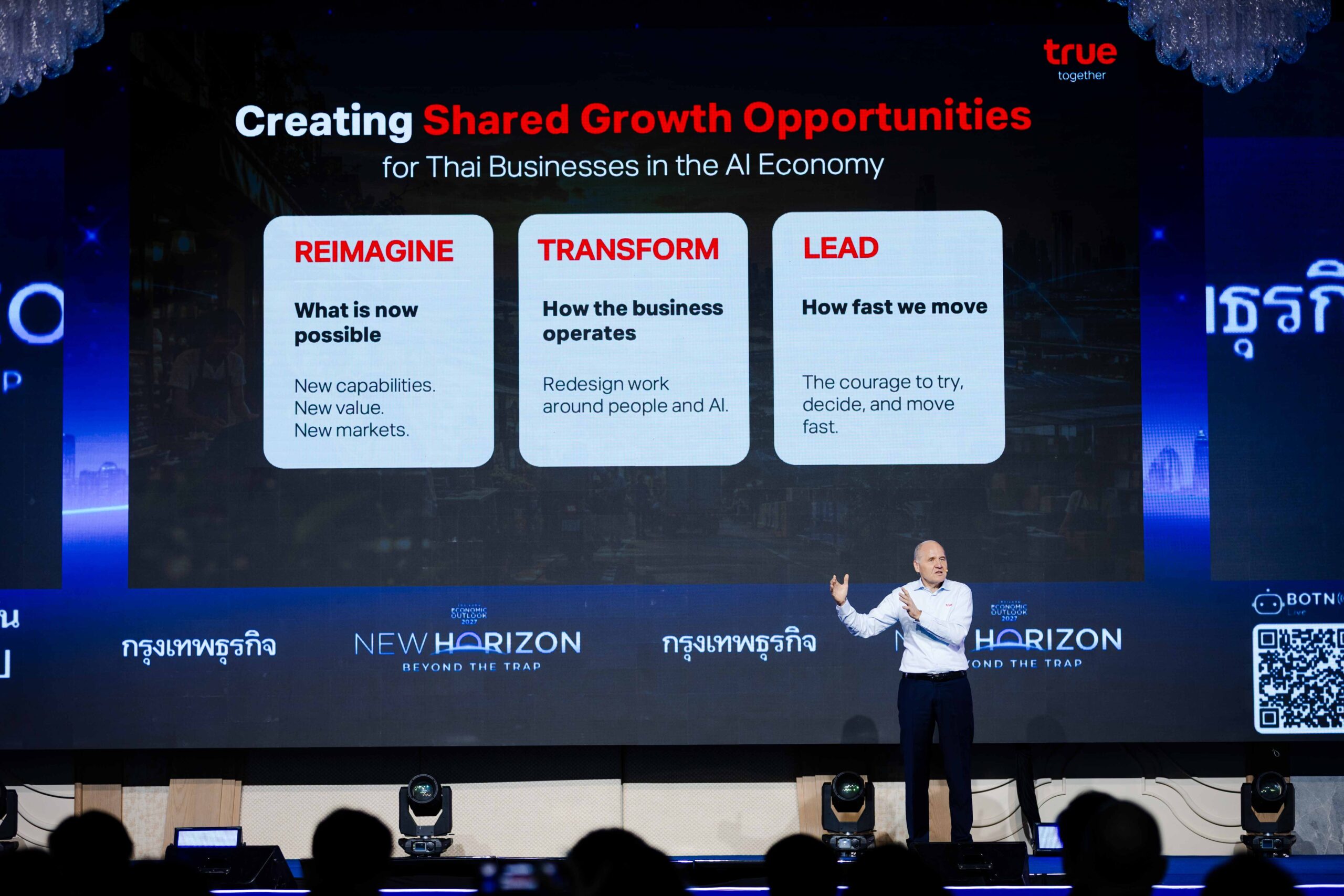
Moving up these levels takes more than technology. I suggest a simple framework of Reimagine, Transform and Lead.
Reimagine what AI now makes possible. AI is more powerful and accessible than ever, so limited staff and budgets no longer close doors. The clearest opening is in how customers discover products, as AI agents increasingly compare options and recommend the best fit. BCG found that in roughly 63% of AI-assisted purchase journeys, AI introduced consumers to brands they would not otherwise have considered, shifting advantage from media spending toward relevance and data clear enough for AI to understand.
Transform how the business operates. This is the hardest step, because it means letting go of the mindset behind past success. Real gains come step by step, through the three levels above.
Lead with speed. AI moves too fast for traditional long-term planning. Leaders need a North Star without pretending three-year plans can predict the technology, and must bring employees along. Here, SMEs have an edge. With fewer legacy layers and faster decisions, they can move quickly and challenge larger rivals.
None of this is a purely individual journey. Each step depends on conditions many SMEs cannot create alone, including affordable AI tools, usable data, practical skills, trusted platforms and responsible safeguards. With these foundations in place, AI can help carry Thailand’s local wisdom to wider markets and create greater value.
A Shared Effort
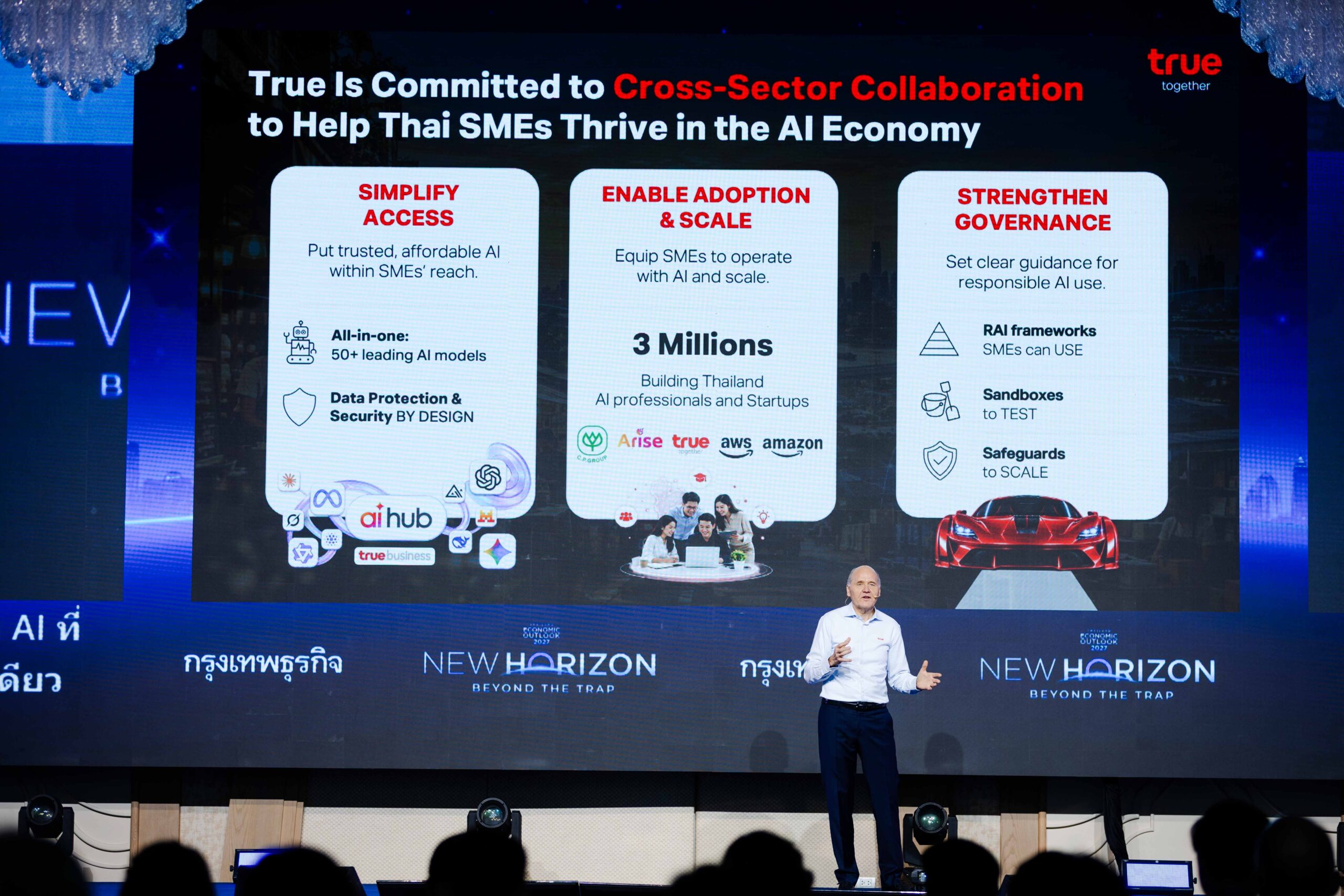
This is why collaboration has to be structural. Government, large enterprises, technology partners and SMEs each shape part of the conditions for adoption. True’s role is to help make advanced AI capability practical and accessible for smaller businesses.
We start by simplifying access. True AI Hub brings more than 50 AI models into one platform, with packages starting at 399 baht per user per month and no large upfront investment, sparing SMEs the cost and complexity of multiple subscriptions.
We also build the skills that turn adoption into scale. Through collaboration with CP Group, Arise Ventures Group, AWS and Amazon, we aim to build AI capabilities for up to 3 million people and support entrepreneurs and startups.
We also hope to contribute our experience on governance. Like a fast car, AI needs good brakes and clear rules of the road, not to slow it down, but to help it go further safely. Data centers have shown that technology often moves faster than regulation, a challenge every country faces. Government and business need to work together on responsible AI frameworks that protect people without blocking growth, as well as sandboxes where SMEs can test safely before scaling.
Access Partnership estimates that AI adoption could unlock at least 2.6 trillion baht in economic benefits for Thai businesses by 2030. The opportunity is real, but it will not reach everyone on its own.
Most AI investment today still flows into infrastructure. That investment is not wasted; it is an asset Thailand must put to full use. Capturing its value means turning infrastructure into usable capability, capability into more productive SMEs, and local wisdom into products and services that can reach larger markets. That is how AI investment can move from numbers on paper to opportunity, productivity and better lives that Thais build and share together.